do you know what en iso 11612 means for your protective clothing?

Not a day goes by that in Marina Textil we don’t talk about or use the EN 11612 standard, we could even dare to say that it is the most important standard when it comes to multi-standard fabrics for personal protection. For this reason, all our fabrics are certified according to EN 11612.

In this post, we explain in brief what the EN 11612 consists of and we leave you the link to three very explanatory videos of the tests included in the standard.

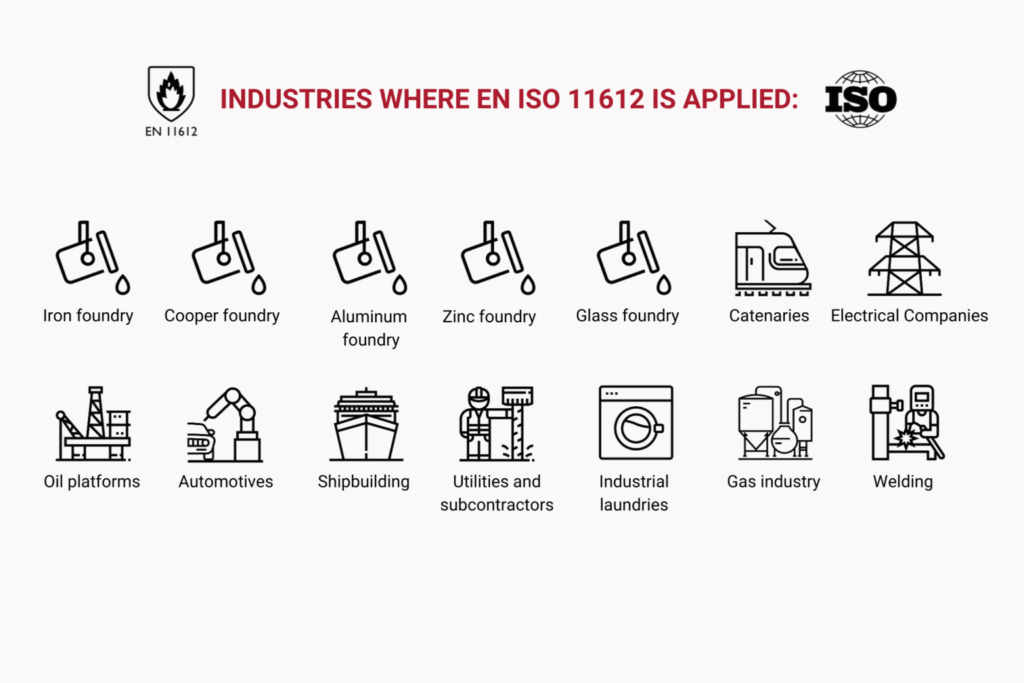
EN ISO 11612 is a European standard that establishes protection requirements for clothing used to protect the user against heat and flames. The standard applies to protective clothing for workers exposed to thermal hazards, such as flames, convective heat, radiant heat, contact with molten metal, and projections of incandescent particles.

The standard establishes requirements for clothing that covers the entire body, such as jackets, trousers, coveralls and protective suits. The clothing must provide a protective barrier against heat and flame, and must be able to withstand exposure to high temperatures for a given period of time.

EN ISO 11612 sets out the following fire, heat and flame related tests to assess the performance of protective clothing (the number and type of tests may vary according to the type of garment and its intended use):

  1. Heat resistance test (ISO 17493): The fabric sample is exposed to a heat source (oven) and the dimensional change experienced by this fabric is measured.
  2. Flame spread test (ISO 15025): This test measures the flame spread of a fabric exposed to a heat source.
  3. Convective heat test (ISO 9151): The fabric sample is exposed to a convective heat source and the amount of energy transmitted through the fabric is measured.
  4. Radiant heat test (ISO 6942): The fabric sample is exposed to a source of radiant heat and the amount of energy transmitted through the fabric is measured.
  5. Molten metal splash test (ISO 9185): This test measures the ability of the fabric to protect the wearer against molten metal splashes.
  6. Contact heat test (ISO 12127-1): The fabric sample is exposed to a heat source and the amount of energy transmitted through the fabric is measured.

In addition, the standard also includes tests concerning the mechanical properties of the fabric, such as tensile and tear strength, shrinkage upon washing or burst strength in the case of knitted fabrics.

It is important to note that EN ISO 11612 is only one of the standards to be considered when selecting the right protective clothing for a specific job. Other factors should also be considered, such as the specific risks associated with the job, the environment in which the work is performed and the applicable occupational health and safety requirements.

Watch the following videos to see all the test methods about EN ISO 11612:
EN ISO 11612 (PART 1)

EN ISO 11612 (PART 2)

EN ISO 11612 (PART 3)

¿sabes qué significa la norma EN ISO 11612 para tu ropa de protección?

No pasa un día sin que en Marina Textil hablemos o utilicemos la norma EN 11612, incluso podríamos atrevernos a decir que es la norma más importante cuando se trata de tejidos multinorma para protección individual. Por ello, todos nuestros tejidos están certificados según la norma EN 11612.

En este post, te explicamos brevemente en qué consiste la EN 11612 y te dejamos el enlace a tres vídeos muy explicativos de los ensayos que incluye la norma.

EN ISO 11612 es una norma europea que establece los requisitos de protección para la ropa utilizada para proteger al usuario contra el calor y las llamas. La norma se aplica a la ropa de protección para trabajadores expuestos a riesgos térmicos, como llamas, calor convectivo, calor radiante, contacto con metal fundido y proyecciones de partículas incandescentes.

La norma establece requisitos para la ropa que cubre todo el cuerpo, como chaquetas, pantalones, buzos y trajes de protección. La ropa debe proporcionar una barrera protectora contra el calor y las llamas, y debe ser capaz de soportar la exposición a altas temperaturas durante un período de tiempo determinado.

EN ISO 11612 establece las siguientes pruebas relacionadas con el fuego, el calor y las llamas para evaluar el rendimiento de la ropa de protección (el número y el tipo de pruebas pueden variar según el tipo de prenda y su uso previsto):

  1. Prueba de resistencia al calor (ISO 17493): La muestra de tejido se expone a una fuente de calor (horno) y se mide el cambio dimensional experimentado por este tejido.
  2. Prueba de propagación de la llama (ISO 15025): Esta prueba mide la propagación de la llama de un tejido expuesto a una fuente de calor.
  3. Prueba de calor convectivo (ISO 9151): La muestra de tejido se expone a una fuente de calor convectivo y se mide la cantidad de energía transmitida a través del tejido.
  4. Prueba de calor radiante (ISO 6942): La muestra de tejido se expone a una fuente de calor radiante y se mide la cantidad de energía transmitida a través del tejido.
  5. Ensayo de salpicadura de metal fundido (ISO 9185): Este ensayo mide la capacidad del tejido para proteger al usuario contra salpicaduras de metal fundido.
  6. Ensayo de calor por contacto (ISO 12127-1): La muestra de tejido se expone a una fuente de calor y se mide la cantidad de energía transmitida a través del tejido.

Además, la norma también incluye ensayos relativos a las propiedades mecánicas del tejido, como la resistencia a la tracción y al desgarro, la contracción por lavado o la resistencia al estallido en el caso de tejidos de punto.

Es importante tener en cuenta que EN ISO 11612 es solo una de las normas a tener en cuenta al seleccionar la ropa de protección adecuada para un trabajo específico. También se deben considerar otros factores, como los riesgos específicos asociados con el trabajo, el entorno en el que se realiza el trabajo y las normas aplicables. Requisitos de seguridad y salud en el trabajo.

Vea los siguientes videos para ver todos los métodos de prueba sobre EN ISO 11612:

EN ISO 11612 (PARTE 1)

EN ISO 11612 (PARTE 3)

FilterS